
When you first look at a Saju chart, all those characters can feel a little overwhelming.
You see four pillars and eight Chinese characters, along with terms such as Heavenly Stem and Earthly Branch. If you are completely new to Saju, it may be difficult to know what to look at first.
So rather than trying to understand everything at once, I recommend starting with one particular character:
your Day Master.
In Korean Saju, we call it Ilgan (일간, 日干).
The Day Master is the Heavenly Stem that represents you in your birth chart. It becomes one of the main reference points from which the rest of the chart is interpreted.
So the first question to ask when looking at your Saju chart can simply be:
“What is my Day Master?”
Where Is the Day Master in a Saju Chart?
A Saju chart is made up of four pillars based on the year, month, day, and hour of birth:
Hour · Day · Month · Year
Each pillar contains two main characters: a Heavenly Stem above and an Earthly Branch below.
Four pillars with two characters each give us the eight characters of Saju Palja (사주팔자, 四柱八字).
But which one represents you?
Look at the Day Pillar.
Then look at the Heavenly Stem at the top of the Day Pillar.
That is your Ilgan—the Day Master.
Find the Day Master in the chart below
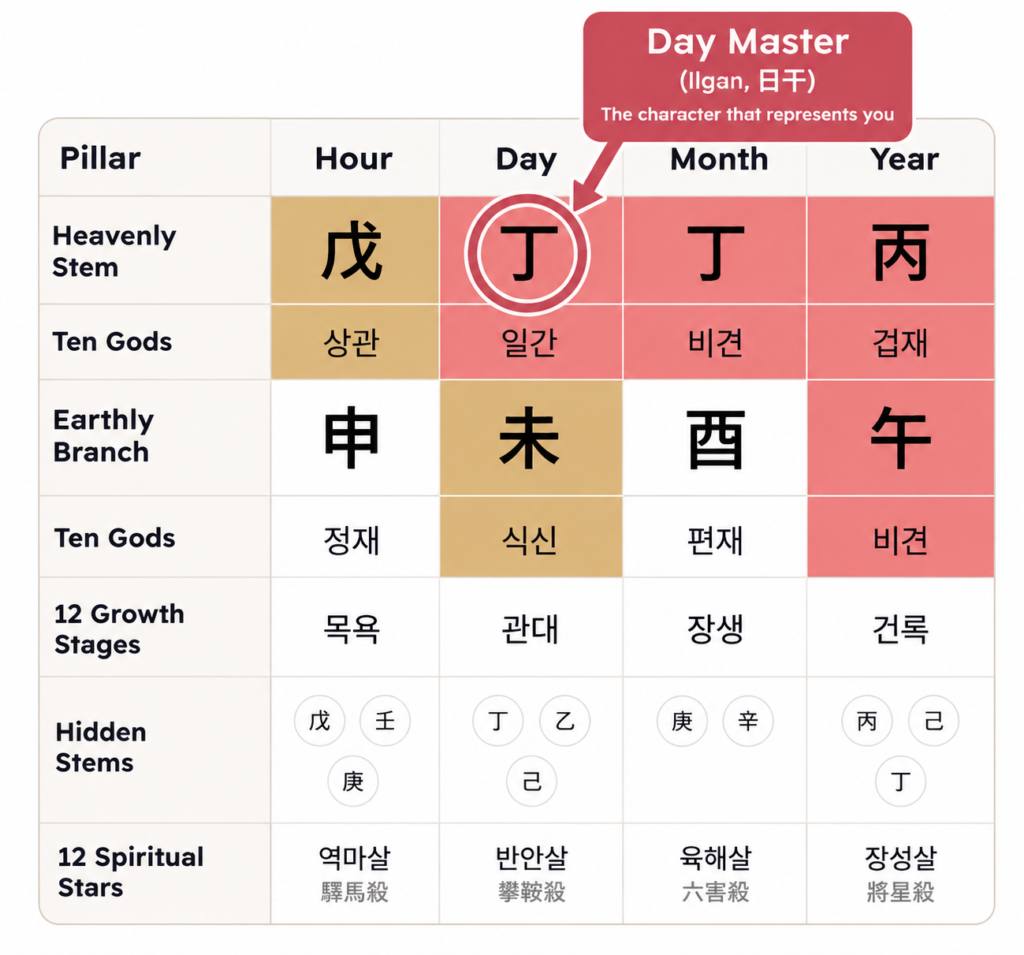
The Heavenly Stem of the Day Pillar is the Day Master (Ilgan, 일간). In the example above, the Day Master is 丁, pronounced “Jeong” in Korean.
If you use the LifeChart Insights chart, simply find the Day column and look at the character in the Heavenly Stem row.
That character is your Day Master.
Why Is the Day Master Important?
One reason I like to begin with the Day Master is that it gives you a clear reference point for understanding the rest of the chart.
A Saju chart contains the Five Elements:
Wood · Fire · Earth · Metal · Water
But simply counting these elements does not tell us everything.
We also need to understand how the other energies in the chart relate to you. The Day Master provides that reference point.
In other words, instead of looking at eight unfamiliar characters and wondering what they all mean, start by identifying the character that represents you.
From there, the rest of the chart gradually begins to make more sense.
Your Day Master Is a Starting Point, Not Your Entire Personality
This is an important distinction.
Once people discover their Day Master, they often want to know immediately:
“What kind of person is a Gap Wood Day Master?”
or
“What is a Jeong Fire person like?”
There are certainly characteristics traditionally associated with each Day Master, and we will explore them throughout this series.
But your Day Master alone does not define your entire personality or life.
Two people can both have a Gap Wood (甲木) Day Master and still be very different from each other.
The season in which they were born, the other Heavenly Stems and Earthly Branches in the chart, the balance and distribution of the Five Elements, and the relationships among those energies all matter.
So rather than thinking,
“I am Gap Wood, so this description must define me,”
it is more useful to think,
“Gap Wood is the starting point from which I can begin to understand my chart.”
That is the approach we will take throughout this series.
The Ten Day Masters
There are ten possible Heavenly Stems that can become your Day Master.
For this blog, I use their Korean pronunciations, rather than Chinese Mandarin pronunciations:
| Element | Yang | Yin |
| Wood | 甲 Gap | 乙 Eul |
| Fire | 丙 Byeong | 丁 Jeong |
| Earth | 戊 Mu | 己 Gi |
| Metal | 庚 Gyeong | 辛 Sin |
| Water | 壬 Im | 癸 Gye |
So the Ten Heavenly Stems are:
Gap (甲) · Eul (乙) · Byeong (丙) · Jeong (丁) · Mu (戊) · Gi (己) · Gyeong (庚) · Sin (辛) · Im (壬) · Gye (癸)
This distinction matters because two Day Masters belonging to the same element are not considered identical.
For example, Gap (甲) and Eul (乙) are both Wood, but they represent different expressions of Wood energy.
Likewise, Byeong (丙) and Jeong (丁) are both Fire, but their qualities and the imagery traditionally used to understand them are different.
That is what we will explore next.
Find Your Day Master
If you don’t know your Day Master yet, create your Saju chart on LifeChart Insights using your birth date and time.
Once your chart appears:
Find the Day column → Find the Heavenly Stem → That character is your Day Master (Ilgan).
Don’t worry about understanding everything else in the chart yet.
For now, simply find that one character.
In the next article, we’ll begin with the first of the Ten Heavenly Stems:
Gap Wood (甲木): What Does It Mean to Have Gap as Your Day Master?
What does Gap Wood traditionally represent? Why is it often compared to a tall tree? And, more importantly, what can that symbolism tell us—and what can’t it tell us—about someone with a Gap Wood Day Master?
That’s where we’ll begin.